Thursday, August 18, 2016

Elbe Bike Route VI: Switzerland in Saxony and Bohemia


We passed some hills starting near Meissen and continuing past Dresden, but as we got another 20 km down the road those hills turned into mountains.  The formal name is the Elbe Sandstone Mountains, but ever since some Swiss painters working in Dresden two hundred years ago said they looked like home, they've been called "Saxon Switzerland" on the German side of the border, and "Bohemian Switzerland" on the Czech side.  The most iconic view is from a rocky outcrop called die Bastei, old German for "bastion," and yes we climbed up there from the river to see this spectacular sight for ourselves.

But first let's back up a little.  A short ways from our last stop, Pillnitz, we came to the town of Pirna.  For several years, the painter Canaletto called it home, and painted its marketplace in the 1750s.  Hasn't changed much, aside from the mobile cheese trucks that now come to the market.


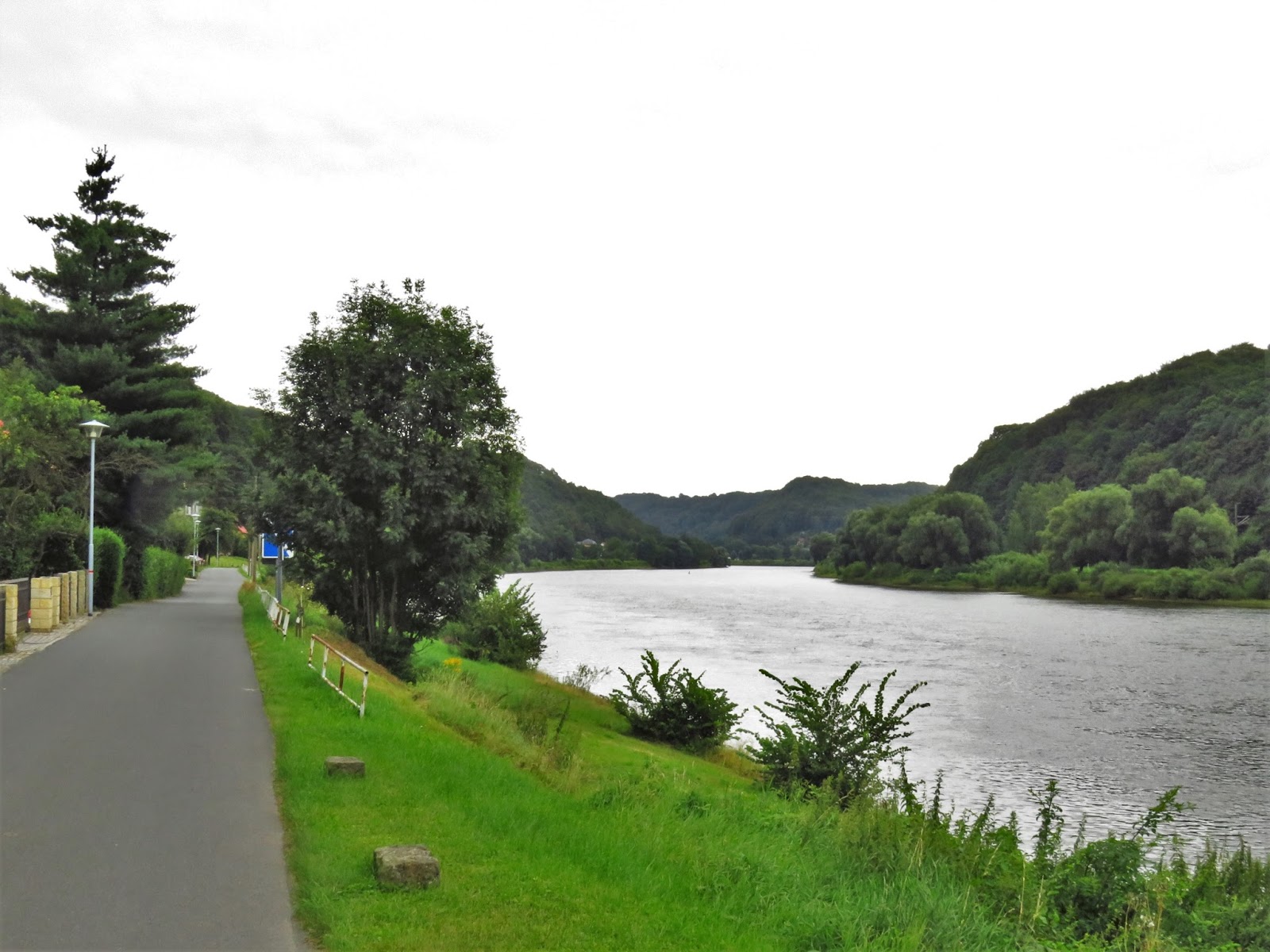
The mountains truly begin just past Pirna,  though we had a hard time seeing them from the bike since we were on the right bank (FYI the convention is to name the banks as one looks downstream), as were the most dramatic parts of the mountains.  However we did have wonderful views of the river from our largely traffic-free road.


We booked two nights at a wonderful hotel near the river and did a shorter hike after checking in and getting changed into hiking clothes.  That's our window at the top of the next photo, and the views started pretty much as soon as our feet were in motion on the hiking path that runs by the front of the hotel.  It was a nice climb to get us limbered up for the main event the next day.


We truly lucked out with the weather that next morning, a little cool and crystal clear.  We started out with a lot of stair steps through the forest.


And then -- our first viewpoint.  WOW!  We think the white "castle" is actually a hotel or perhaps even just a grand house.  But the castle in the distance occupying the entire top of that hill is the real thing, known as Festung Königstein, the King's Rock.  It is one of the largest fortifications in Europe, so large it has 50 buildings within its walls, so formidable no enemy ever dared attack it.


  Looking upstream we could see the reaction ferry that connects passengers from the train station on the left bank with the hiking trails on our side of the river.  Because it's anchored at the shore due to the curve of the river, boats wanting to pass must wait until the ferry is on the right bank.  Down below in the town is the train, looking as if we are back in the Miniatur Wunderland in Hamburg.  Then downstream is the town of Stadt Wehlen and, indeed, a boat that will soon be passing by the ferry.


Just a bit more climbing and we come to an improbable place, a fortress that was once fashioned out of these rocky high points.  It must have been hazardous to health to move about before these steel walkways came in!  It was even more hazardous to come up uninvited, as this reconstructed catapult shows.


It was also hazardous for just plain folks who started coming up to the Bastei in large numbers in the middle of the 19th century.  In the 1860s the king of Saxony accommodated them with the formidable Bastei Bridge, now another 'must photograph.'  For some idea of what it was like before the bridge, we have a painting done about 40 years earlier by Caspar David Friedrich.


Not all the great views are of the bridge and the river.  Here are a few looking away from the river and into the heart of these eroded sandstone mountains.


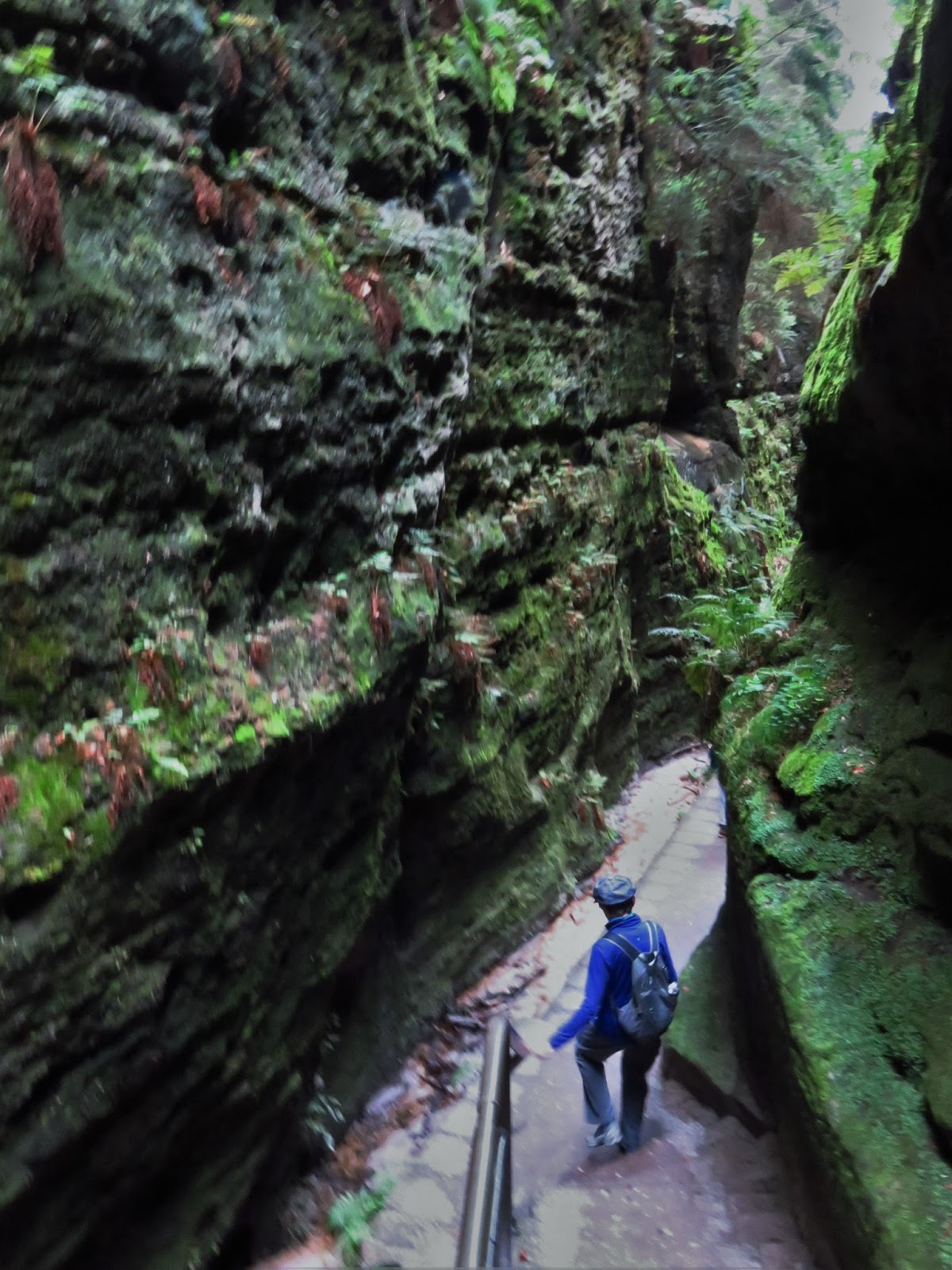
The descent was predictably fast.  We took a route called the "Swedish Passageway."  Not sure what the Swedes were doing passing through this way.


It was still only 2 o'clock, so we did one more hike, up the much less visited 'Little Bastei.'  It was a pleasant climb, much shorter and almost devoid of other hikers.  From the top we got a great preview of our route further up the Elbe (we start with that ferry across to the left bank).  A close-up shows just how popular this area is for bike touring:  just in this one shot we can see 12 pannier-laden bikes!


Next morning we took the ferry across just in time to see a Viking cruise boat go by, with a sidewheeeled steamboat right behind it.  These steamboats run up and down about 50 km of the Elbe from Dresden to Schmilka, the last town in Germany before the Czech border, and provide a nice alternative to the trains which also stop at all these towns in Saxon Switzerland.


Although we didn't stop and climb up to it, we did get a closer look at  Festung Königstein as we rode
under it on the left bank. 


Soon after it was yet another ferry back to the right bank to visit Bad Schandau, where we checked in early, got into hiking clothes, and took the 118-year-old Kirnitzschtalbahn trolley 8 km (the full extent of the line!) for another hike.  It was a fairly rough trail, so the best part of the adventure was in fact the trolley ride up this narrow valley.  That and finding a German name with six consecutive consonants uninterrupted by a vowel!


10 km into our ride the next morning and we reached another milestone, and a stopping point for today's blog -- the Czech border at Hřensko.  It is the lowest point in the Czech Republic, as the Kamenice River joins the Elbe, now called the Labe in Czech.  The Kamenice valley is a major entry point into the so-called Bohemian Switzerland and a new (2000) national park.  Since we did not have good info on how hilly it might be, we decided not to find out the hard way and kept going along the Elbe/Labe and enjoyed the view of Bohemian Switzerland from there.


We've been in Germany now for 37 days, and Jeff's high school German has gotten a bit better but is far from fluent.  Nonetheless, it has gotten us through some challenges such as a dental emergency and a bicycle rim emergency, plus at least two dozen nights in hotels where no one spoke English.

Crossing the border into the Czech Republic we were greeted by a sign that was reassuring and unsettling at the same time: it was clearly put up there for cyclists, but what the heck did it actually say?  Czech is a Slavic language with little resemblance to anything we know.  How will we do?  Well, check back in a few days when we've made it to Prague and we'll let you know!


Sunday, August 14, 2016

Elbe Bike Route V: Meissen and Dresden, the Cultural Heart of the Upper Elbe

With our bike now repaired in Torgau, we set out for Meissen, home of the Meissen Porcelain Factory and Museum, with Dresden to follow.  As we approached Meissen we saw something we had not seen before on the Elbe, hills.  We had seen some sand dunes, including some that were so covered in trees they looked like hills, but these were the real thing!  We also encountered some trail surfaces that, in keeping with our new resolve to protect the bike rims, we dismounted and walked.  At least some of the negativity of that issue was offset by a pair of picnic spots, one for each of the two days it took.


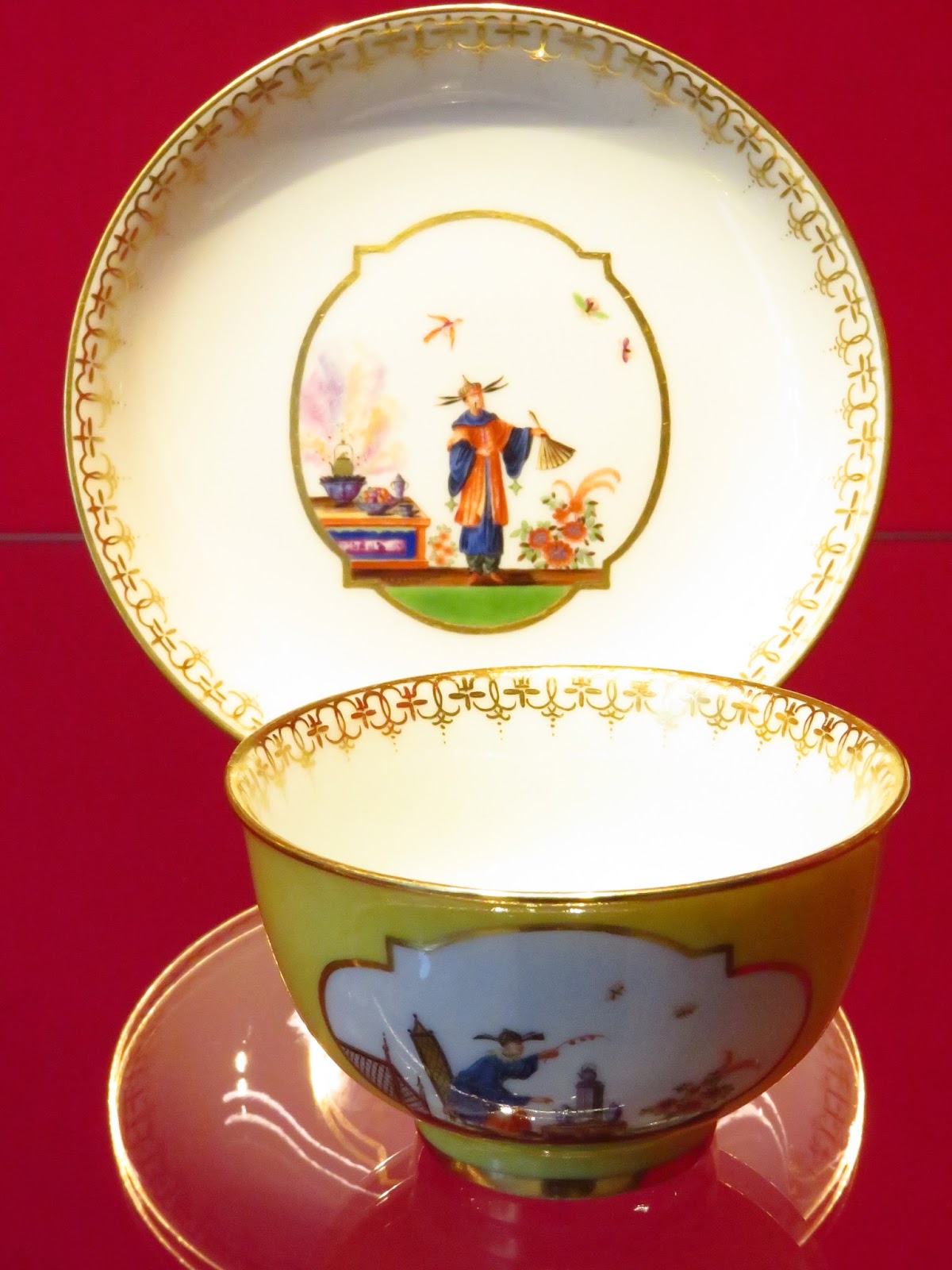
The second day was short so that we could check into our pension, change into walking shoes, and trot 1 km over to the Porcelain Museum.  All worked as planned and we had an interesting time there.  While waiting for the first part of the tour, we had a chance to see some Meissen porcelain up close, with price tags to temper the enthusiasm.  Golly this stuff is pricey, with each of these sets over 2K!  BTW, the prices are in euros, so well over two grand in dollars.


Then we had a 45-minute introduction to how the porcelain is made and formed.  Most of it is actually made in a mold, although a statue like this may have a dozen or more sections made in different molds and then carefully -- sorry -- molded together.  The figure on the right has not yet been fired, the second one shows how much it shrinks, as well as lightens in color.  After the initial firing it is hand-painted and then fired a second time, or multiple times when there are multiple colors.


Then we had as much or as little time as we chose to have to wander through the museum.  As our regular readers can guess, it was not a short visit.

One interesting piece combined a statue of miners extracting feldspar with samples of the three ingredients of Meissen porcelain:  kaolin, feldspar and quartz.


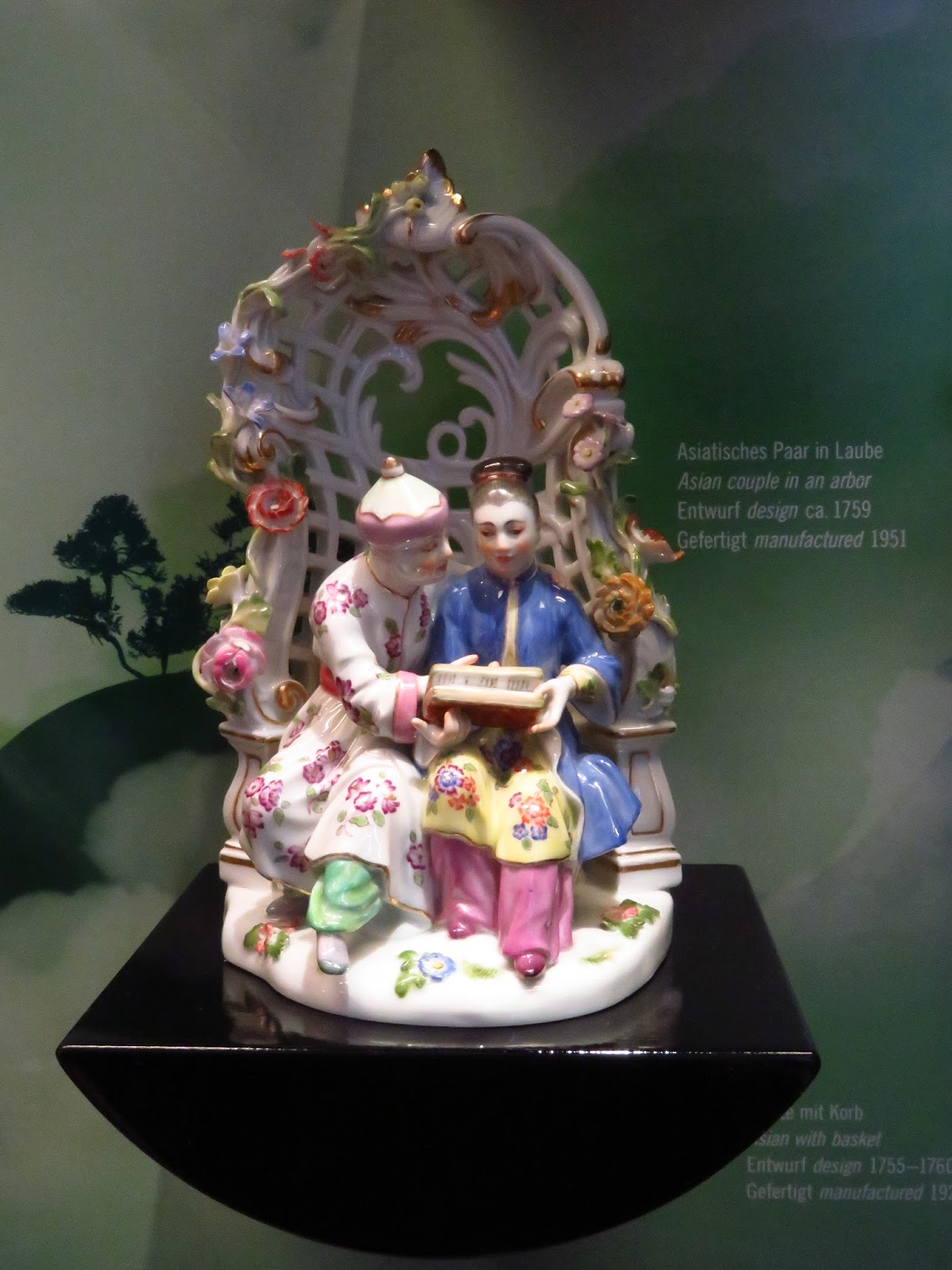
Meissen Porcelain was first created in 1710 and was inspired, of course, by china that had been entering Europe for a century or two.  Quite naturally, many early pieces mimicked oriental designs.


Very early on, the company made decorative statuettes and knick knacks, as well as the high quality tableware that was their mainstay.


Of course, porcelain followed many of the same artistic trends as painting and other decorative arts.  The first item below was made for a World's Fair in the 1890s, the second for one in the early 1930s.  But you already figured that out, right?


Ironically, two of Meissen's largest markets today are in the Far East: Japan and Taiwan, where they gobble up porcelain zodiac figures such as these.


From Meissen to Dresden it was only 27 km, less than 90 minutes of biking.  The folks in the Viking tour boat we passed probably took twice as long, particularly going upstream against the brisk flow of the Elbe.  Along the way both they and we enjoyed seeing more hills, this time with the occasional vineyard and/or manor house.


One final surprise, a Dutch windmill along the trail, with a nearby sign educating us on all the fish in the Elbe (and their German names).


Our home for three nights was an apartment we found through Airbnb.  It was wonderful, filled with light and the warm glow of trees outside the windows.  The street was quiet except for a half hour each morning when it came alive with a steady stream of young kids heading, usually with a parent or two, to the elementary school across the street.  Having a kitchen also gave us a chance to do some home cooking, which our stomachs appreciated after so many restaurant meals.


Dresden escaped much of the bombing of WWII until February 1945, when it was hit with one of the most devastating attacks of the war.  It's actually surprising to see much of the city looking almost normal and streets like the ones in this neighborhood looking old, until you realize that there are gaps where obviously new buildings have replaced ones that couldn't be rebuilt.  It's hard to know as well how many of these older buildings are actually new buildings inside old shells of homes that were burned in the attack.

The most famous ruin was that of the Frauenkirche, or "Our Lady's Church."  The East German government kept it in ruins as a reminder of the attack by British and American planes.  After reunification a push was made to rebuild it in its former glory, and after more than a decade of work, it reopened in 2005.  Outside you can see the juxtaposition of the rebuilt old church dome, some obviously new architecture surrounding it, and a large pit which is planned for rebuilding in the near future but which just as obviously has been an eyesore for some 70 years.  From the main square, however, all you see is the glory of the church, and of Martin Luther out front.


Step inside, and you are almost certainly saying "WOW!"


While digging through the rubble in the 1990s, workers stumbled onto the cross which once topped the church.  Rather than repair it, the cross was put aside as one visible reminder of the destruction, and a new gold cross was erected with donations from British citizens in a gesture of reconciliation.


Nearby is the recently reopened Albertinum, the city's famous art museum that focuses on the 19th and 20th centuries.  Not surprisingly, they have a good collection of German romantic painters, especially Caspar David Friedrichs.  Here is his View over the Elbe Valley, painted in 1807.


View of Dresden at Full Moon is a terrific painting by someone we're not familiar with, Johan Christian Dahl.


Karl Blechen's moody 1826 painting, Gothic Church Ruins, seems also eerily prescient, foreshadowing the many church ruins Germany would have 120 years later.


We'll close with two paintings by another German painter previously unknown to us, Gotthardt Kuehl, done at the end of the 19th century in a style obviously evolved from the French Impressionists.  The first is Augustus Bridge, Dresden, in Snow and the second The Garden Room.


The rebuilding of the cultural center of Dresden is finally nearing completion (parts of the Zwinger are still in progress and a few empty spots in the center are finally being built on), and it is quite stunning.  Here are a few shots.


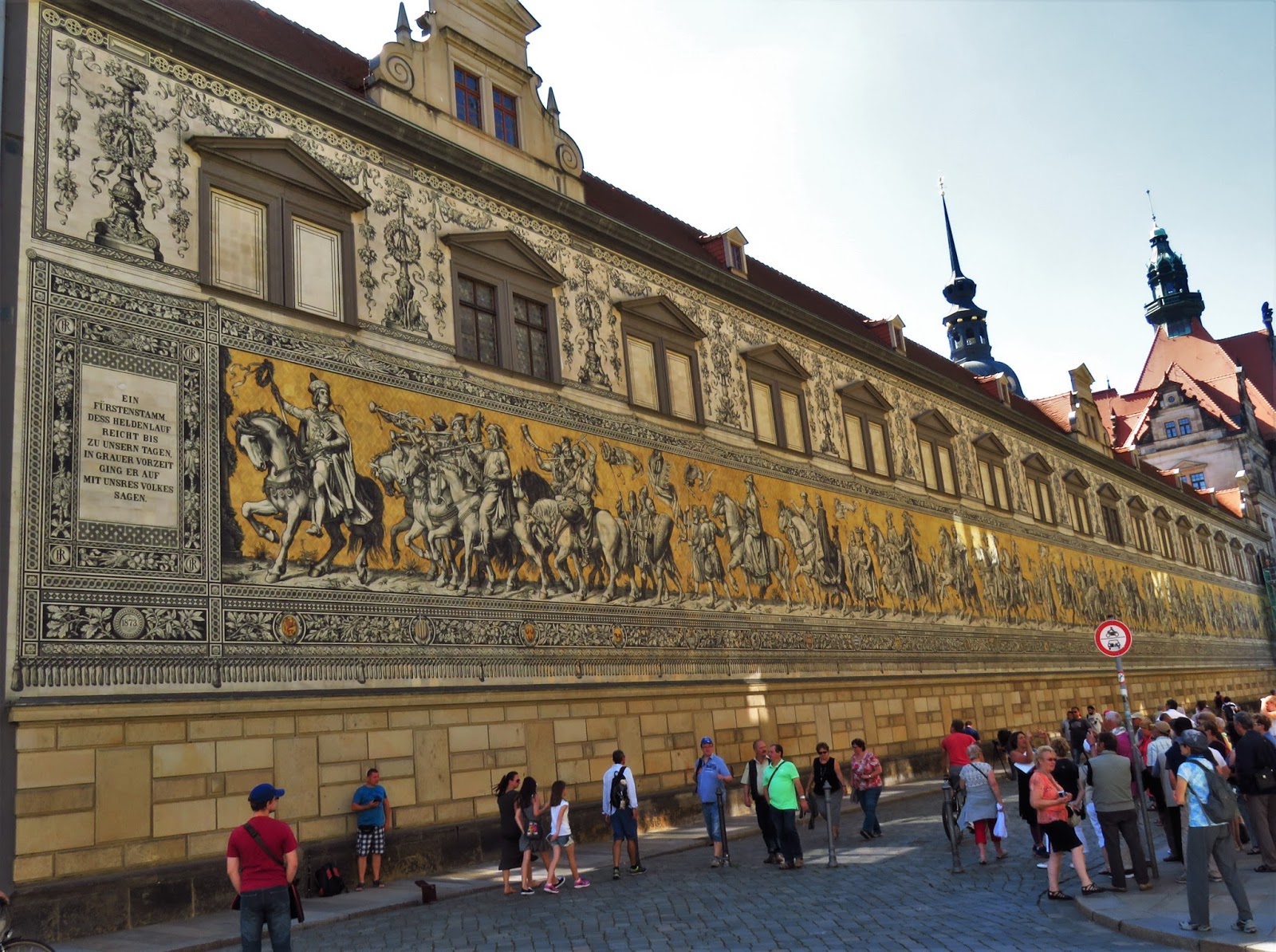
Two items are worthy of special mention.  One is a procession, in thousands of Meissen tiles, of the various rulers of this part of Germany.  It runs along one wall of their palace, and covers the rulers from shortly after 1000 AD to the 1870s.


The other is the Zwinger, yet another palace complex nearby.  It now serves to hold several museums. We didn't go into any of them, but it sure was fun to walk around the large complex.


Our final exploration in Dresden was in the Great Garden, a large park we could reach on the city tram.  Large parts are forest, yet more large sections are lawns that stretch into infinity, but it did have some gardeners showing how they achieve perfection with the topiary, and a few flower gardens that brightened things up.


Did you catch that all four of these are dahlias?  They are our favorite flower, since they were the flower of choice for our wedding.


The park is also famous for a train.  Actually a miniature train, run in part by kids.  Children 10 years and up can learn how to do many of the jobs over the winter, then start doing them during the summer season.  This fellow told us he was 11 years old when we caught him on his way to work, as it were.  And sure enough, he helped dispatch our train several minutes later.  FYI, it was an adult actually driving the locomotive. 


The day we left Dresden we biked 21 km to .  .  . Dresden!  Actually to a place called Pillnitz, but it's still officially part of Dresden.  Along the way we spotted several palaces and castles high above the Elbe on the right bank, and a bridge called "The Blue Wonder" spanning the river.  It went up in 1895 and was considered quite a long bridge at the time.


After taking a ferry to the right bank we missed a turn in the bike route and found ourselves on a wondrously bad piece of path once again, but it had the pleasant effect of giving us a close-up view of the sidewheeler steamboat that plies this part of the Elbe.


Our destination was Schloss Pillnitz, where we had a room immediately adjacent to the palace and decorated in quite suitable colors, since Pillnitz is most famous for its gardens.


It was a garden worth seeing, with the plantings enhancing the matching wings of the palace and a camellia tree that is over 250 years old, quite possibly the oldest one in Europe.  Each Fall that greenhouse slides over on a pair of tracks and protects it from the cold German winter.


We'll close with Pillnitz Garden's clever pair of botanical peacocks.  Our next blog entry will be from a little further up the Elbe, the area called "Saxon Switzerland."  You'll see why when we get there and have the photos to show it..