Monday, June 3, 2013

On the Bike from Vienna to Győr


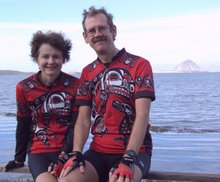
On Jeff's 66th birthday, 33 days after leaving Seattle, we finally mounted the tandem to start our bike trip on the Danube, Main and Rhine Rivers.  If all goes as planned we will ride 1,300 - 1,500 miles in Europe followed by about 500 in England between now and August 15.

It certainly started well with a send-off from Konrad and Zosia and their parents Cordelia and Jazz.  We rode about 100 meters on their busy street, then got onto this bike path and others like it that guided us right through Vienna.  There were busy streets to cross, but it was all on bike paths.  Once in the Prater district we rode down the Hauptallee, a grand boulevard now closed to all motor vehicles.  That took us to still more paths through parkland and ultimately across to the north side of the Danube, where the third photo was taken.  To jump ahead a little, by the end of day 3 in Győr we had pedaled 160 km, 150 of them on bike paths and bike trails!


Day 1 was 73 km/44 miles, a bit of a push for folks who haven't been on a bike in over 5 weeks.  However, the trails were mostly flat and smooth-surfaced and we had a terrific tail wind.  An otherwise dull ride going in a straight line for miles with trees on each side gets more exciting when you see that you're moving along at 28-32 kph / 18-20 mph.  We also were excited to see many long-distance bike tourers, mostly on single bikes but a few couples on tandems like these folks from Holland who are camping their way across Austria and Hungary.

Though following the Danube, for the middle 40 km of day 1 we were in fact mostly in the forest of the Danube River Floodplains National Park, on the north (left) bank of the river.  We crossed back to the south side at Hainburg, a fascinating place.  There are three gates in the city wall.  The Vienna Gate is indeed on the western edge, and was built in 1460.  It's one-way, traffic lights letting cars go first east-bound, then west-bound.  The Hungary Gate on the east side was similar, but the traffic now goes through a breach in the wall next to it.  The third opening, the Fisher Gate that leads to the Danube, has a tragic story attached.  As the Turkish army approached in 1683, townspeople rushed to the Fisher Gate, hoping to swim across the Danube to escape.  But the door opened inward, and got jammed by the mass of people.  Only 100 out of Hainburg's 8,000 inhabitants escaped, and this narrow street is now called Blutgasschen,  'Bloody Alley.'


One of those 100 lucky ones, however, was Thomas Haydn, later to be the grandfather of composer Josef Haydn.  The town square in front of the church is now named for him.

For a few km the Danube is the border between Slovakia to the north and Austria to the south, then for 200km more it separates Slovakia from Hungary.  But Bratislava, on the north bank, is the capital of Slovakia, and in the Treaty of Versailles it was given a semicircle of land on the south bank about 10 km in radius.  Thus as we approached on the south bank, we came to our first border crossing.  It was a non-event.  Under the Treaty of Schengen, border crossings in Europe are no longer needed.  Grass was starting to reclaim the area where cars once queued up to enter Austria from Slovakia, and our bike trail did not even have a sign telling us when we had crossed the line.  Soon after we started seeing some of Bratislava's recent urban sprawl, moving west along the river and south across the river, from the ancient red-roofed Castle of Bratislava.  As we got closer, we could see the new building next door to the Castle that is now the seat of the Slovakian parliament.


Our first lodging was a "botel," the boat with the red roof.  We had a comfortable room on the river side and watched the barge traffic go by, about 2-3 mph going upstream, more than twice that going down.


Our botel was right on the edge of Old Town, an area about 5 blocks north-south and east-west where no cars are allowed.  It was filled with ancient buildings, a few of them historic, almost all of them intriguing.  Plazas popped up here and there, today filled with phalanxes of tables for outdoor dining.  Sadly, it had not gotten out of the 50s all day, so we dined indoors.


The next morning we left our packed panniers at the botel and headed past the St. Michael's Gate that looks like a church and the building next to it that the guidebooks claim is Europe's narrowest house, at 1.3m (51").    Our destination was the Castle, 85 steep meters above the Danube.  We were looking down at the main bridge into town, the one with an observation deck known as "The UFO," when we noticed a procession of bicycles led by a police car with flashing lights.  On and on they came, about 500 of them, for some sort of local bike event.  Car traffic didn't resume for about 5 minutes.


Day 2 was an easy 40 km to Mosonmagyarovar, Hungary.  Lunch the day before in Hainburg had put Jeff to a test of his German, which he last studied in 1966.  Since neither his high school nor college German teachers thought it important to know the German vocabulary for restaurant menus, he was pretty lost until he fished out a pocket phrase book.  We enjoyed a flavorful lunch, and just as importantly, one where we actually knew what we were eating.

Now Bratislava is in Slovakia, and Slovakian is not a language we could make head or tail of.  But we found a restaurant with menus in Slovakian, German and English, and did just fine. 


How would we do in Hungary?  Slovakian is an Indo-European language with at least a theoretical relation to English or German, though we saw scant evidence of that in any signs we saw while walking about.  Hungarian has several Siberian languages as its nearest linguistic relatives.  What hope did we have that we would know potatoes from pig's knuckles (a Hungarian favorite, by the way) on a menu?  As it turns out, almost all Hungarian menus are in at least two languages.  If it's only two languages, however, the second one is . . .  German!  So the first five soups on this menu are Liver Dumpling Soup with Beef Broth, Cream of Garlic Soup, Bean Goulash Soup, Bone Broth with Homemade Noodles, and -- you figured this one out yourself, didn't you? -- Hungarian Goulash Soup.


Since we crossed the Danube near Vienna, we have been on Eurovelo 6, one of 14 marked bicycle routes that criss-cross Europe.  EV6 starts in France but meets the Danube in Germany and follows it downstream all the way to the Black Sea, long past where we hop off in Budapest.  As it turned out, we followed the easy-to-spot blue EV6 signs all the way to Győr, and for about 80% of the following kilometers to Budapest.  We'll be following other Eurovelo routes later this summer along the Main and Rhine Rivers, so getting lost this year is going to require a real effort.


And what a route it is!  On day 1 and the start of day 2, much of it was on river dikes.  Then we moved a bit inland and followed country roads, but always on marked bicycle paths a meter away on one side of the road or the other.  Since the trails themselves are 2-way, it didn't really matter whether we were on the north or south side of the road.  Crimson-red poppies appear to be the dominant wildflower here, often forming a colorful border to our bike path.  At other times, we noticed mistletoe above us in the trees.


Coming into Mosonmagyarovar, the EV6 signs sent us onto this ancient street.  Around the bend was the entrance to the "old castle," across what was once the moat.  Parts of the castle have been converted into a small college.


We were totally unprepared for our next discovery.  Mosonmagyarovar has 350 dentists, even though the whole city had only about 3,500 inhabitants!  It's not that they have a candy factory in town . . . Rather, it's that "Moson" is close to Austria and not that far from other European countries with expensive dental care, and one of Hungary's positive legacies from communism was a large supply of dentists and dental assistants willing to work for much less than their western European colleagues. In short, the town has a thriving "dental tourism" industry, with people coming from all over Europe and the U.S. when they need extensive dental work done.  Our hotel, in fact, turns out to be owned by a dental partnership, and we could have gotten an even better lodging rate if we'd only needed some crowns replaced or dental bridges repaired.

We had a large, attractive room, as you can see, and downstairs was another local treasure, an attractive massage therapy room and an accomplished massage therapist who gave Louise a 30-minute Swedish massage for about $15.  Just as we were about to leave Vienna two days earlier, we noticed that Louise's seat suspension had broken.  A tandem stoker (the person on the back seat) needs a suspension seat post more than most cyclists because the geometry of a tandem is such that the bike gives the stoker less cushioning from jolts.  Then, as we were riding out of Vienna, Louise spotted a large bike store that was already open.  They had a perfect replacement.  Because it was shaped a little different than the post it replaced, however, Louise rode half a day with her saddle set too far back, and her leg started to complain about that, fairly insistently.  The Mosonagyarovar massage was just what we needed to have a happy stoker once again.

We walked a few blocks to a pedestrian street full of restaurants that were empty.  It was about 6 pm on a Saturday.  When we mentioned to the hotel desk clerk that a fellow could fall aleep in the middle of that street and not get hurt, she laughed and said he'd get trampled later that night when all the young people got up from their Saturday afternoon naps, where they've been getting ready for a full night of partying.  We didn't go back to check out her theory.

Next day was another easy one through small towns, such as this one that had two reimagined visions of the past.  First was a family mansion that was begun in the 16th century, recently renovated as a hotel.  A few doors away was a thatched-roof house, recently renovated by the addition of a satellite dish. Hey, time marches on.


Our third night, where we will end today's entry, was Győr.  It has long been an important city, protecting the upper Danube from invaders from the East.  In 1529 and 1683 it failed, however, to stop the enormous Ottoman Turkish attacks that were in both cases eventually stopped at Vienna.  So Győr has had to rebuild, in fact to repopulate, a few times.  Our lodgings were suitably historic: a cloistered Carmelite monastery built in 1725.  It is attached along one wall to the Carmelite church.  It was a Sunday, and when we poked our heads in about 5:15 Mass was being said and the church was packed.  We headed instead to the nearby basilica where we photographed the stained glass windows, but by 5:45 people were arriving for 6 o'clock Mass and a choir of three voices    sang verse after verse of a haunting hymn that had us transfixed for a while.


Győr started renovating even before the great changes of 1989 in Eastern Europe, and we found in 2013 a large well-restored historic center of town that was closed to cars but not entirely a tourist area, more like a residential district with a lot of history.  Its quiet charm made it, in retrospect, the high point of our journey from Vienna to Budapest.


The jaunt to Budapest changed in character a bit as we left Győr behind.  We'll explain more in our next blog post.

Vienna


We've now started our biking in Vienna, but before we get to that -- in our next blog entry, in fact -- we want to say something about what we saw here but more importantly about the transition we went through while here, from fairly stressed-out travelers on the move for 4 straight weeks to cyclists ready for the slow lane.

Getting to Vienna with our two suitcases, two backpacks and two large, heavy bike cases was a challenge.  The train has no baggage car, everything goes in the train car you sit in.  For a time we were in panic, we just didn't see how this was going to work, since we were not the only folks with bags that were too big to go in the overhead racks.    Passengers streamed in from both ends of the car, more than there were seats for for the first 2-hour leg to Dresden.  But somehow, it did work, and we were finally able to breathe normally and enjoy the scenery.  In Vienna, a friendly cab driver at the train station understood Jeff's high school German even though Jeff couldn't understand a word of his rapid-fire, heavily-accented Viennese German.  We and our luggage had made it to our friends Cordelia and Jazz in Vienna.  That's one big item we could now take off the Angst List.

Cordelia and Jazz gave us a big welcome, and their kids Konrad and Zosia were excited to have some new playmates.  Jeff was soon playing catch in the living room using a Nerf ball with sports-crazy 6-year-old Konrad, each toss of the ball accompanied by commentary:  "O'Malley really put some wood against that ball . . . Jasinski is going back, back back . . . Can he get it? . . . He's leaping . . . YES! . . . The crowd goes wild!"

Then it was time for artsy 4-year-old Zosia to show us her Gustav Klimt coloring book.  We had been forewarned of her interest in him, and had a Klimt sticker book ready for her that we picked up at the Toledo Art Museum 2 weeks earlier.  She was charmed.


Jazz and Cordelia are both on the faculty at UW Oshkosh, with the "W" obviously being Wisconsin, not Washington.  Cordelia teaches German and Jazz International Studies, and they are in Vienna this Spring because Jazz won a Fulbright scholarship to teach at the Diplomatic Academy in Vienna plus do some research.  The "DA" was founded over 200 years ago by Empress Maria Theresia to train folks for the civil service of the Austro-Hungarian Empire, while today it is a graduate school focusing on International Relations. 

Our first full day in Vienna was a Sunday, so Jazz could join the rest of us on a trip into the heart of Vienna, only a kilometer from their apartment at the DA.  Konrad talked his folks into paying for the daily paper so he could read the soccer scores for the teams he has been following since they got to Europe 3 months ago.  Then, before getting into full sightseeing mode, we stopped at a playground for the kids to be kids.


Next it was into the narrow streets of the First Bezirk, the heart of Vienna.  We stopped at several churches, two where we could take in all their baroque splendor, two where Sunday mass was being said.  We paused at the second of these, trying to puzzle out what language the hymn was being sung in.  Not German, Polish, Russian.  Didn't sound Slavik, so probably not Slovak or Serbo-Croatian.  By elimination, we finally decided it must be Hungarian.


On we went past the Plague Monument, erected to thank God for ending the plague in 1679, and the copper-domed Hofburg, the emperor's home when he was in Vienna.  We passed two of the many places where Mozart or Beethoven once lived, as both made Vienna their home for many years, and passed many fellows dressed in the clothing of that era, trying to lure tourists to a nightly concert of Mozart and Johann Strauss music.


We wandered through one century-old "indoor shopping mall" then stopped, as all visitors to Vienna must do, at an ancient coffee house.  Our choice was the Cafe Central, and it did not disappoint either in decor or in its choices for coffee and desserts.  We completed our tour with a stroll past the Mozart statue, complete with a G-clef flower arrangement.


On day two it was time to tackle another stressor, reassembly of the bike.  We've owned the bike 6 years but only reasembled it twice before, most recently 4 years ago.  At our age, a lot of memory disappears in one year, let alone four, and it took five hours to accomplish the task thanks to two complications.

The first was the switch to larger tires so we wouldn't have to worry about unpaved bike trails, which we know we will have from time to time here.  Readjusting the front fender took only 5 minutes, but the back fender took a lot more until Jeff decided to just drill a new hole in the fender to create more clearance.  Bingo, that did the trick, at the cost of an extra half-hour.

The other problem was bigger.  We were missing a part.  When disassembling the bike, Jeff had mistakenly removed the front derailleur.  Bad move.  It's really hard to find the precise spot to reattach it to on the seat tube.  Adding to the challenge was a missing nut.  Jeff pulled a new bolt and nut from his spares collection, but it wasn't quite right so he cinched the derailleur up enough to make the bike rideable and checked the Internet for a nearby bike store.  Two days later we did ride it 2km to the shop, and Jeff made sure he knew the term for front derailleur, 'vorne Schaltwerk.'  They adjusted it perfectly.  Check off the last major item on the Angst List.

We'll, almost.  Jeff is 97% better from a slight cold he caught on the cruise ship that only slowed him a little, but Louise seemed for a day or two like she might have a worse time of it.  She rallied for our night at the opera -- more on that in a moment -- then felt worse for a day, then perked up by departure day.  OK, maybe don't have to stress out about that after all.


Monday night we went with Cordelia to the Vienna State Opera.  It's in a beautiful building on the Ring, the grand boulevard that indeed rings the inner city.  Inside was as ornate as outside.  We were in the next-to-last row but not too far off-center, and the acoustics were actually superb.

The performance was far beyond 'superb.'  We have each seen Carmen five or six times, and this was unquestionably the best yet.  Both the orchestra and the singers were absolutely top-notch, but besides that it was "grand opera" in the grandest possible way.  First, the setting was early 19th century Spain, not a bare stage like one production we went to at Seattle Opera.  Second and more importantly, it was peopled with huge numbers of performers who made the scenes come alive.
 
 
Most opera companies have choruses of 20-30 men and women who might be villagers in one scene, nobility at a ball in another, and so on.  Here there were at least 40.  Other opera companies might put 5-10 additional characters onstage in non-singing roles, called supernumeraries.  Here, there were dozens.  In the first act, there were 60-90 people onstage for almost every scene.  As Act Two opened in Lilias Pastia's tavern, there were the six principal singers, ten flamenco dancers, and 80-90 "customers," half of them from the chorus.  Then bullfighter Don Escamillo entered with about 20 more folks!  There wasn't an empty square meter onstage!  Sorry we can't share the spectacle with you visually, but we think you can see why we thoroughly enjoyed it, and understand why the Vienna Staatsoper is considered one of the top companies in the world.

 
Though Louise's cold trimmed our sightseeing a little, we still did get to quite a bit in our week in Vienna.  With Cordelia and Zosia we took the subway to Schönbrunn, the palace once considered to be out in the country from Vienna, that the Habsburgs built to rival Versailles.


Another day on our own, we went to the Belvedere, a palace turned art museum where Gustav Klimt's iconic "The Kiss" resides. Photos out the windows and in the garden were OK, but not of the art itself. As you can see in the shot to the left taken from the Belvedere, the Stefansdom, or St. Stephen's Cathedral, truly dominates the center of Vienna even today.


 And it has for centuries.  While the kids were in their half-day kindergarten we went to the Vienna Museum and saw a painting of Vienna in 1690 and a great model of the city about 1850, shortly before the walls of the city were demolished and reshaped into the great Ringstrasse.  They had served the city well in 1683, keeping out the Turks until a relief army led by the king of Poland ended the siege on September 12, 1683, as depicted in this famous painting also in the museum.


We also admired the museum's painting of Austria's most famous empress, Maria Theresia, flanked here by her husband and by a few of her 16 kids.  Her youngest, Maria Antonia, was not yet born when this was painted.  You might recognize that child more readily by the name the French gave her when she married Louis XVI: Marie Antoinette.


With all those views of the Stefansdom, we had to explore it in person.  Colored glass in the windows give it an odd look inside.  Not sure what the story is behind those figures carved into the pulpit.


We paid a few euros for a tour of the catacombs below the cathedral and adjoining square.  Until 1783, most everyone buried in Vienna was buried here, 11,000 in all.  When they ran out of room for coffins, prisoners were sent down to clean and stack the bones from old coffins -- tibias here, femurs there.  We saw it all, but out of respect for the deceased, no photos.  We next climbed the tower, for a few more euros, and did get photos of some gargoyles as we ascended, and of the city below when we reached the top, 343 steps above the city.


 Well, Thursday afternoon the FedEx guy dropped by and left with the empty cases that once held our bike.  They will be in Amsterdam where we will pick them up in August.  No turning back now!  Guess we need to start biking!  We'll tell you how it went in our next blog entry.