Tuesday, March 4, 2008

Welcome to Coastal Georgia

We started and ended this segment with a storm. Last week we raced a line of thunderstorms into Fernandina Beach and watched from our hotel as it raged for the next 5 hours after we checked in. We laid over the next day not to avoid rain, which by then was well gone, but wind.
There was a 20-25 mph wind out of the north, which would have been a nasty headwind indeed. Instead we had a blustery 14-mile ride without the panniers, much more manageable, and visited the nearby town to search out new novels to read (Jeff is going through 2 a month when not studying maps or writing the blog, Louise about 5 a month). Just before sunset we took one more beach walk and gathered up interesting shells for this shot.

In earlier planning we hoped to cross into Georgia about March 1, and we ended up being 2 days ahead of that, having biked 1075 miles through Florida in just over 6 weeks. As you can see from the math, we've not pushed the miles because there have been lots to see.


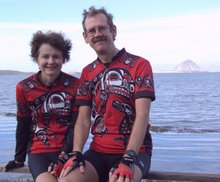
We were excited to enter Georgia because it promised to be reasonably bike-friendly. Heck, we had even gotten a state bicycle map from GADOT, and it showed route "Bike 95" running right up from Florida to Savannah, mostly using US 17, the coastal route that is now paralleled by I-95 and therefore not overly busy. Well, the reality is that there are indeed signs, and there has been a shoulder almost all the way, but that shoulder is frequently about as wide as in this shot at the border, about a foot across. Near Brunswick it got wider, but then they put rumble cuts into it, making it virtually unrideable. Fortunately the road was 4-lane with light traffic, so we were mostly left alone in the right lane by cars moving over to the passing lane. By the way, Louise is bundled up because we had our first truly cold day entering Georgia on Feb. 28, in the low 40's early on and only warming to the low 50's.

In Florida we had learned about the 16th - 18th century competition for empire from the Spanish perspective at St. Augustine. Now we were in British territory, and the history took a new slant. The Spaniards kicked out the French in 1565, but in the early 1700s the French started moving eastward from Louisiana and considered returning to the area that is now coastal Georgia. The Spaniards and English both looked at the area from their strongholds of St. Augustine and Charles Town (now Charleston), but the British moved first and established a fort in what is now Darien in 1721 that scared off the French, and then on St. Simon's Island in the 1730's, about the same time
Savannah was established as the first settlement in Georgia. King George's Fort in Darien has been recently reconstructed, and they did a terrific job of making it look quite realistic. We visited it today, just missing a big weekend when they expect about 100 "reenactors" to arrive for a mock battle. A truly mock battle, as the fort was never attacked in its brief existence.

That's jumping ahead a few days. One of our first sightseeing stops in Georgia was Ft. Frederica
on St. Simon's, a town of 1000 people for a decade, now a peaceful field interrupted by signs showing where streets once lay and a handful of building foundations uncovered by archaeologists. A few miles away was this bucolic site on the edge of a marsh where Scottish soldiers ambushed a Spanish force that had come up from St. Augustine to kick out the Brits from Ft. Frederica. Instead they suffered defeat and caused the land to adopt the name it now holds,
Bloody Marsh. It was 1742 and the last attempt by the Spanish to attack the British north of them.

We spent one afternoon exploring Jekyll Island,
where we enjoyed a few miles of bike trails,
this wonderful tunnel of oak trees,
a windswept shore, and a walk through a remarkable place, the Jekyll Island Club historic district. In the 1880's a group of some of the wealthiest men in America bought the entire island and built a comfortable hotel. A few of them built "cottages" nearby, not anything as outrageous as those in
Newport RI but far beyond what you or I would call a cottage. The club failed to survive WW II and the State of Georgia bought the island, restoring the hotel and leasing building lots to far less wealthy lovers of the Georgia sea islands. Except for the historical district, it had a bit of a '50s look to it. Our following day on St. Simon's Island found it much more upscale and busy, and perhaps you can see some of that
in this photo from a pier on Jekyll Island looking toward St. Simon's. A bridge goes from St. Simon's to Sea Island, but it "privatized" a few years ago, and cars driving onto that island must turn around and head back unless they can show a reservation for one of the ritzy resorts there.

Speaking of bridges, we had an exciting time going up the Sidney Lanier Bridge on
the way into Brunswick. We used the granny gear for the first time since leaving New York (that's the small chainring that gives you REALLY low gears) and stopped at the top for this nice view from 200' above the water.
We spent 2 comfortable nights in
WatersHill B&B in Brunswick, seen under the Spanish moss in this photo. The historic district was quite charming, and the mile walk to dinner was actually fun since it went down this leafy street with enormous live oak trees
in the median strip and past at least a dozen houses that would turn heads in any town.

To really understand the Georgia and Carolina coasts, we understood we needed to visit a rice plantation, for it was rice, not cotton, that created great wealth in this part of the South before the Civil War. Georgia actually forbade slavery for its first dozen years, but when it came it came hard. Rice farming was more labor-intensive and dangerous to the health, because of malaria, than cotton growing, and large tracts of cypress swamps were turned into rice fields in the early 1800's manned by huge workforces of black slaves. One of these, Hofwyl-Broadfield Plantation,
was left to the Nature Conservancy in 1973 in the will of the last owner, after 5 generations in the same family spanning 160 years. In a survey in 1849 they counted 357 slaves running it. After the Civil War they had to pay workers, of course, and face stiffer competition from rice plantations in Louisiana. This one grew rice
longer than most, until 1913, then survived as a dairy farm. The rice fields were left alone, and are slowly going back to marshland. This part of Georgia has as many large live oak trees draped in Spanish moss as Seattle has espresso stands, but Hofwyl-Broadfield State Park (the Conservancy was only an interim owner)
had some of the most impressive, including a few with names! You may have to click on this picture to see Louise standing next to the Miss Ophelia Oak, which they guess is somewhere between 500-800 years old.
You do see Spanish moss on almost anything that stays still for a while, as you can see in the other photo.

We're now at a fantastic B&B, Open Gates in Darien. We planned on 2 nights here in order to go kayaking on the Altamaha River.
We went by ourselves in a tandem kayak and found coordinating a kayak tandem a bit harder than a bicycle tandem. Without a timing chain to force us into the same cadence, we had some "conversations" on that topic from time to time. We were driven about 6 miles upstream so as to have the ebbing tide pulling us seaward back to Darien,
but as we got into the wider water we found that the east wind balanced out any tidal forces going on there, and we got quite the workout. Lifting up a coffee mug the next morning found us discovering muscles we had forgotten about for a while, but we did enjoy the trip. Dinner at a terrific seafood restaurant like they have in Darien can cure many ills, especially when you order shrimp that's fresh off these shrimping boats that call Darien home.


Well, we started this segment with a storm and now end it with one. We had a tough choice to make for today. The forecast was for a fantastic tailwind, 15-20 mph, all day, but with the chance of severe thunderstorms going to 30% at noon, 70% at 3 pm and 100% by 4. Add to the calculations that the only place with accommodations en route is 48 miles from here. We were tempted, sorely tempted, by that tailwind, but we stayed a third night. Of course it helped when the owner said we could use her washer-dryer and the computer in the library. So enjoy today's blog, brought to you by thunderstorms and composed wearing clean clothing with that nice fresh-out-of-the-dryer warmth. Hopefully it has cheered up the writing.

Monday, February 25, 2008

Back to the Beach, Then Back in Time


After an easy ride through empty pine scrubland east of DeLand, we suddenly hit dense residential areas as we got within a few miles of I-95 and succeeded in finding roads with bike lanes or with bike-friendly sidewalks that got us through Daytona Beach to the ocean. Our arrival was carefully timed to miss the departing NASCAR crowd by one day and the start of "Bike Week" by one full week. Alas, NOT our kind of bikes.


And what a beach we found! As the highway approached the beach from the west, we expected the only options to be north or south, paralleling the beach. But the road continued to a toll booth, where cars can, for $5, drive right onto the beach! The sand is astonishingly compact, and in fact it was car racing on the beach almost a century ago that led to the creation of the Daytona 500.
Today you can race your car at any speed you like, so long as it is under 10 mph. You have to stay well inland of the water,
and get off every few miles for pedestrian only areas. In fact, few cars drove by us in the next 2 days of walking along the beach, and never bothered us.

Our stay was terrific, thanks to Paula and Mike,
next-door neighbors to us in a B&B 3weeks ago. They offered us use of their cottage 2 blocks from the beach, and it was perfect: cute, cozy and convenient. It's hard for us to get consistently healthy meals just from restaurants, and for 3 days we cooked the healthiest, best tasting suppers and breakfasts. We thank Paula and Mike profusely, and we are sure all our body parts thank them as well.


The beach was mesmeric, so much so that we ended up walking 25 miles in 2 full days off the bike -- so much for "rest days"! The surf, the shorebirds, pelicans gliding by in close formation like the Blue Angels in slow motion,
the endless stretch of hard-packed sand ... we just kept walking and walking, as if in a sand-induced trance.
On day two we reached a park with walkways through the sand dunes and a forested area to the lighthouse that marks the end of the peninsula. THIS was the beach experience we had come to Florida for!


Our 58-mile ride from Daytona Beach to St. Augustine was as easy as any ride of that distance we've done. There was a paved shoulder most of the way except in tony Ponte Vedra, where we took a local road that was narrow but fascinating as it went past beautiful house after beautiful oceanfront house. It had the added feature of a 25 mph speed limit which we almost hit, thanks to a light tailwind, but not a problem, the cars hardly passed us as they all seemed to obey the limit as well, despite their petrochemical-driven ability to exceed it more easily than we could.


St. Augustine was amazing. This place was 211 years old while Tom Jefferson was writing the Declaration of Independence! The reason for its founding is simple: the French had set up a fort near modern-day Jacksonville, which worried the Spanish king, and staffed it with French Protestants, which put the king in a frenzy. Add to this the fact that treasure ships headed to Spain with the wealth of the New World sailed just off the coast, and something had to be done. The town was founded in 1565 and almost disappeared the same year, as the French wasted no time in attacking. But the attackers were cut off by Spanish reinforcements from Havana, and that was the last of them. St. Augustine came close to extinction a few more times from fire, disease, and unfriendly Indians and Englishmen, but survived.
To our amazement, we discovered that Florida once had more missions than California, all of which closed when Florida was handed over to the British in 1763 as the result of Spain being on the losing side of the Seven Years War. If you click on the photo you can see the detail in this map, which shows only about one fourth of the missions the Spanish founded in and around Florida.


In the late 1600's the Spanish got serious about a fort to protect the place, and built Castello San Marco --
over a period of some 40 years. It was attacked 13 times, and it survived every one of them, including two lengthy sieges. During those sieges the entire population of 1300 people lived in the fort, and the accommodations were a tad tight. The sieges failed in part because of the
building material, coquina, a type of soft limestone with shell fragments that was said to "swallow" cannon balls lobbed into it, rather than smash apart. The detail here is of a portion of the original wall about the size of a modern brick.


To help bring history to life, the Park Service has found gunpowder-happy volunteers who dress up in army costumes of the 1600's to give a cannon-firing demonstration several times a day. It was a blast, as they say, despite the fact that the Park Service does draw the line at providing these pyrophiliacs with actual cannon balls.


The town can be expensive to walk through, with numerous places using "Historic" (sorta old), "Old" (a tad older), "Ancient" (getting REALLY old) or "Oldest" in their names to draw in the unwary tourist.
But for no cost at all you can walk through the old city gates (St. Augustine, like Quebec City, was once completely walled for protection) and down a pedestrian-only street where many ancient (sorry) buildings are and get
a fine feel for long-ago. You can also walk nearby to one of the less-well-known sights in town, the "Love Tree," where an oak tree has a palm tree in a woody embrace, to put a G-rated label on it.


We did surrender $12 for two tickets to tour a college. Now, that probably seems odd to a lot of you, as it did at first to us, but this is no ordinary college. Henry Flagler has been mentioned in the blog before -- he built the fabulous resort hotel The Breakers in Palm Beach, and he built Flagler's Folly, the railroad to Key West. His first foray into Florida however, armed with fabulous wealth earned as Rockefeller's partner in Standard Oil, was to St. Augustine. In 1888 he opened up the most expensive hotel built in America to that day, then called the Hotel Ponce de Leon, but home since 1969 to Flagler College, a 4-year liberal arts school. The hotel was designed by the architects who built the New York Public Library, and the glass and interior design was by Tiffany.
These pictures hopefully speak for themselves as to how beautiful this place still is. The hotel building is mainly used for its dining room and meeting rooms, with the original hotel rooms now housing female college students. Newer buildings nearby house classrooms and male students.
Is this not the most amazing college dining room you've ever seen? Small wonder we felt the tour price worth paying.
We're now in the upper right-hand corner of Florida, as it were -- Fernandina Beach. We had an easy day's ride to Atlantic Beach yesterday, with enough energy to walk 7 miles along yet another hard-packed beach where birds once again outnumbered the people, and an easier still time of it today riding a strong tail wind to Fernandina Beach as thunderstorms approached.
We arrived none too soon, and watched a good demonstration of angry weather all afternoon through the window of our hotel room. We'll close with this photo of the ferry that
brought us across the St. John's River today, and with two very different views from the road into Fernandina Beach. After a day playing on the beach tomorrow, we're off to Georgia. Talk to you next from there!

Monday, February 18, 2008

Connecting With Old Friends and New Trails

We left you last in Sebring, visiting Gary and Carol Speary. The next morning we had a tandem escort out of town, and Carol operated the "stoker cam" to get these two pictures of us in action.
We had a fast ride on back roads through orange groves to the none-too-subtly-named town of Frostproof, where the Spearys headed back and we kept on to the town of Lake Wales, which sits on the shores of Lake Wailes (go figure -- that's not a typo, folks!). Since we had blazed a fast pace to beat a front of thunderstorms moving in, and perhaps look good to the Spearys, we had done our miles before lunchtime.
The next day threatened thunderstorms all day, so we stayed put for a day and a half and explored the town on foot, with raingear in our backpacks. We stopped at the town library both days, but having just written a blog entry, we found ourselves actually reading books there -- you know, those VCR-tape-sized things with paper inside that libraries stick on the shelves around the public-use computer terminals?

Once the storms moved on, our next challenge was to get across the fairly urban landscape around Winter Haven and its neighbors, which run together for many miles of congestion. A detailed AAA map worked wonders, and we somehow got all the way through, riding either on shoulders of (just) adequate width, or on back roads with little or no traffic. Our goal was to reach the Auburndale Municipal Bike Trail and the Van Fleet State Bike Trail, which uses the same abandoned rail corridor but doesn't yet quite connect. The internet helped us find Lake Juliana Fishing and Lodging, a collection of mobile homes rented out usually to fishermen. Forewarned, we had picked up supper and breakfast items, and cooked a terrific sea scallop dinner with all the fixin's, and enjoyed 3-egg omelets for breakfast. The only downside was that the clothes we wore there smelled of cigarette smoke for a few days afterwards -- a small price to pay for the chance to cook our own dinner for a change.


The two bike trails were terrific: smooth-surfaced, wide, extremely rural and totally flat. With a light tailwind pushing through the trees, we averaged 18 while still getting a good view of the Green Swamp that the trail runs through, headwaters of several important Florida rivers. After 20 miles on the Van Fleet
we took a back road off to the northeast which brought us to Groveland, and then had a short ride from there to Clermont, where we put up at the "Old Bicycle Inn." A Google search showed a few places to stay in town, but of course we checked that one first, and it worked out quite well for us. The owner was so impressed with our adventure, he arranged an interview with a reporter from the local paper. We hope to have more info and perhaps a URL to the article, which we have not yet seen, next time.

When preparing for the trip, Jeff had gone through the online alumni directory for his high school to see if there were any classmates living near our route. Turns out one of them, John Gmuer and his wife Doris, retired to Clermont.
Now Regis is not your ordinary high school. It's in the heart of New York City, a few blocks from the Metropolitan Museum, but is fairly small, about 550 students in 4 grades. It was established by an anonymous "benefactress" some 95 years ago, and is the only private school in America that has never charged tuition -- admission is by academic scholarship only. One of its early alums became the incredibly gutsy priest who took on the Mafia on the Brooklyn waterfront, a struggle dramatised in On the Waterfront with Karl Malden playing "Father Barry." More recently, Patrick Fitzgerald, the prosecutor who won a conviction against Scooter Libby, and Dr. Anthony Fauci, perhaps the most famous leader of the fight against AIDS, have brought fame to Regis.

The alums are quite loyal, both emotionally and financially.
The reality is that the endowment only covers part of the cost, about $19,000 per student, and alumni donations are now a major part of what keeps this school going. Jeff went back for his 40th reunion, and found that it is still as academically challenging as when he went. Indeed, he considers his third year Homeric Greek class at Regis the toughest but most rewarding course he ever took. In any event, Jeff and John had a good time recalling their days at Regis and in gauging how each had changed in the subsequent 43 years since they last saw each other!

Our original plan had been to bike in one day from Clermont to Mount Dora, but by the time we looked for rooms, there were none to be had there, in part due to the running of the Daytona 500 some 60 miles from Mt. Dora -- that's how far the housing crunch spreads! This turned out to be a boon for us. We tracked down a B&B in Winter Garden, only 15 miles from Clermont, and thoroughly enjoyed riding the 50 miles to Mt. Dora over two days. In the past year the county has extended a 3-mile bike trail in Clermont another 8 miles to connect with the West Orange Trail, and
we ended up riding every one of the 36 miles of connected trails. The Clermont Trail was not a railtrail, and proved to be remarkably hilly but wonderful, as it is one of the best-built trails we have ever been on. We really liked their way of handling street crossings, seen in this photo.
We saw numerous cyclists, including this tandem couple whose names we did not get, and many walkers and bladers as well. When we came into Winter Garden,
we found that the trail, like the rail line it replaced, went right down the middle of the main street. You can see in the photos how that potential lemon was turned into lemonade.


Our B&B, the Historic Edgewater Hotel, is actually an old hotel, solid as a rock -- it's survived 5 hurricanes and a near miss from a tornado -- and is run as much to help enliven the town as to make a profit. We had a room with a private bath, a twin bed and a double bed, for $75, and that included the best B&B breakfast we've had in months. The trail, the reopening of the hotel, and much more can be traced to civic activism that has turned a town that was dismissed as "Winter Garbage" by some into perhaps the most charming small town we've seen in Florida. That evening, we went across the street to a theater that dimmed its movie projector about the same time Jeff graduated from high school -- in 1965 -- to see the first production in its reincarnation as a home to live theater. We hadn't heard of The Musical of Musicals before, but enjoyed the idea of seeing a musical produced in the style of 5 great musical comedy writers and composers, such as Rogers and Hammerstein, Jule Styne and Andrew Lloyd Weber, and indeed we saw a great show.

But that's jumping ahead a little. We arrived in Winter Garden at lunchtime, and found a delightful pizza place in the ground floor of the Edgewater, with outdoor tables facing the bike trail. However, there were no vacant tables. Seeing this, a couple waiting for their lunch to arrive invited us to sit down and join them, moving their bike helmets off two empty seats for us. Roger and Jean proved delightful meal companions, and we learned how they had recently been transferred by Roger's company from central New Jersey to Orlando . We talked about our bike trip, and mentioned that we had just met up earlier that day with one of Jeff's classmates from a small high school in New York City. "Which one?" asked Roger, his eyebrows arching with interest. "Oh, it's called Regis -- have you ever heard of it?" replied Jeff. "Class of 1962" said Roger, grinning from ear to ear!
And so we resumed reminiscing about dear old alma mater for a second time that day! Such a small world!

We're almost done with central Florida. We saw the rest of the West Orange Trail, another top-notch bike trail,
then found reasonably low-traffic roads to Mt. Dora. They were narrow, shoulderless and hilly, but the relatively few cars that passed did so with lots of room for us, and the scenery was more like that of the Northeast than anywhere else we've been to in Florida. Indeed, John Gmuer told us back in Clermont that it's that resemblance to the Northeast that has made the Clermont area the fastest-growing part of Florida in recent years, and what brought them there as well.

Though we missed seeing any, we've heard of t-shirts saying "I climbed Mt. Dora." It's a local joke. There's nowhere around there that's even 300 feet above sea level. Queen Anne Hill in Seattle, for comparison, is over 400' high. It was billed as quaint in some guidebooks, but that's probably stretching things a bit. It does have the 125-year-old Lakeside Inn, where we stayed, and we enjoyed reading our novels after dinner sitting in the lobby of this grand old wooden hotel. Tonight we're in DeLand, home of Stetson University (yup, their nickname is the "Stetson Hatters"). In less than 30 miles or riding tomorrow, we'll be back on the ocean. More about that next time.